What's the difference between a retirement village and a rest home?
These two terms get used interchangeably — but they describe very different situations. Understanding the distinction matters because choosing the wrong one, or moving too early or too late, has significant practical and financial consequences.

The short answer
A retirement village is for people who are still largely independent but want community, security, and lifestyle support. A rest home is for people who need full-time, supervised care because they can no longer manage safely on their own.
They are not two points on the same spectrum — they are fundamentally different types of accommodation with different purposes, different costs, different financial structures, and different regulatory frameworks.
THE MOST COMMON MISTAKE
Families sometimes move a parent into a retirement village when they actually need rest home care — either because the village sounds more appealing or because the family hasn't fully acknowledged the level of care required. The reverse also happens: families consider rest home care before exploring whether the right in-home support or retirement village could keep their parent independent for longer. Getting the right fit matters.
Retirement villages — what they are
A retirement village is a community of housing for older people — usually 55 or 70 years and over — where residents live independently in their own unit. They cook their own meals, manage their own day, come and go as they choose.
What the village provides is community, safety, and peace of mind: like-minded neighbours, shared facilities, staff on site, and the reassurance that if something goes wrong, help is nearby.
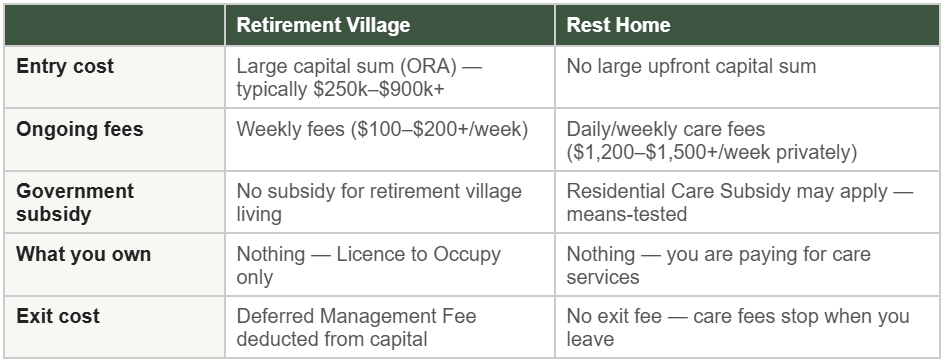
Residents typically pay a large capital sum — an Occupation Right Agreement — for the right to live in their unit, plus weekly fees for the village's operational costs. They do not own the property. When they leave, a Deferred Management Fee is deducted from the capital they paid.
Retirement villages are well-suited to people who:
Are still independent but find the family home isolating or more than they need
Want the social life and activities a village community provides
Value the security of having people nearby without needing hands-on care
Want a lower-maintenance lifestyle without full-time support
Are planning ahead — moving before a crisis forces a decision
Retirement villages are not well-suited to people who:
Need personal care, medication management, or overnight supervision
Have significant dementia or cognitive decline
Are already struggling to manage basic daily tasks safely
Would find the community setting restrictive rather than supportive
Rest homes — what they are
A rest home (also called a residential care facility) provides full-time, supervised care for people who can no longer live independently. Residents live in a shared care setting where staff are present around the clock and meals, personal care, activities, and health monitoring are provided.
Rest homes are licensed and regulated by the Ministry of Health. They are regularly audited against the Health and Disability Services Standards and must hold a current certificate of compliance to operate.
Funding for rest home care may be partly covered by the government through the Residential Care Subsidy, depending on your parent's assets and income. A means assessment is carried out by Work and Income to determine eligibility.
Rest homes are well-suited to people who:
Can no longer safely manage personal care, medication, or meals on their own
Have fallen repeatedly or are at significant risk of falls
Have dementia or cognitive decline that makes living alone unsafe
Need overnight supervision or support
Have medical needs that require regular clinical oversight
The care levels within residential care
Not all rest homes offer the same level of care. In New Zealand, residential care is generally divided into:
Rest home level care — for people with moderate support needs
Hospital level care — for people with complex medical needs
Dementia care — specialist units for people with significant cognitive decline
Psychogeriatric care — for people with serious mental health and dementia needs
A person's appropriate care level is determined through a formal needs assessment (InterRAI assessment), not by the family or the rest home itself.
How the financial structures differ
This is where the two types of accommodation diverge most sharply — and where the most misunderstanding occurs.
Our guides on Rest Home Costs, Retirement Villages and occupation rights agreements have more information.
IMPORTANT
The Residential Care Subsidy for rest home care is means-tested against assets. For many New Zealand families, the family home is the primary asset and its value affects eligibility. Getting independent financial advice before a rest home move — not after — can make a significant difference to the financial outcome for your parent and their estate. This is a specialist area; a general financial advisor may not have sufficient expertise.
Can a retirement village transition to rest home care?
Many retirement villages have a rest home or hospital-level care facility on site, and residents can transition there when their needs increase. This is one of the genuine advantages of a village — continuity of community even as care needs change.
However, the financial arrangements change significantly at this point. Moving from the village unit into the on-site care facility involves a separate contract, different fees, and potentially a new means assessment for the Residential Care Subsidy. The village's ORA is wound up when the resident leaves their independent unit.
Not all villages have on-site care. If continuity of care matters to your family, it is worth asking about this specifically when visiting any village.
Which is right for your parent right now?
The honest answer is that it depends on where your parent's needs sit today — and a realistic assessment of where they're likely to be in two or three years.
If your parent is genuinely independent, socially isolated, and managing a home that's more than they need, a retirement village is worth exploring.
If your parent is already struggling with personal care, safety, or daily tasks, a needs assessment for rest home care is the more appropriate starting point.
If you're genuinely unsure, a needs assessment through Canterbury's NASC service is the right first step. The assessor can help clarify the appropriate level of care without any obligation to proceed with a particular option.
A NOTE ON TIMING
The most common regret families express is waiting too long. Moving to a retirement village while your parent is still active and well gives them time to settle, make friends, and genuinely enjoy the lifestyle. Moving in a crisis — after a fall, after a hospital admission — means starting in a new environment when your parent is at their most vulnerable. If the conversation is on your mind, starting it earlier is almost always better.
Related Pages and Guides